
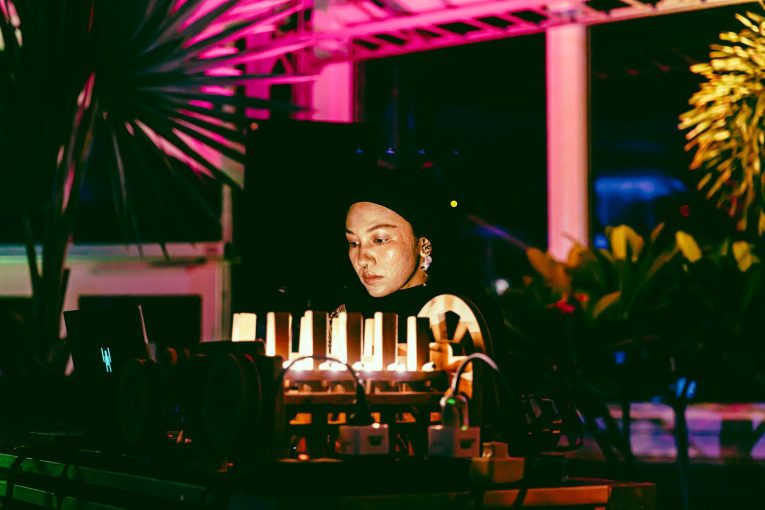
The fall of 2025 in Canada was marked by deep cultural resonance from Southeast Asia, carried by Indonesian sound artist, composer, and ecological activist Rani Jambak. Born in Medan with Minangkabau roots, Rani brought the voices of her homeland in West Sumatra to international stages.
Across her packed six-city Canadian tour, Rani not only showcased experimental electronic music, but also delivered strong philosophical and ecological statements.
At the center of this statement was her unique creation: Kincia Aia: A Living Heritage—a traditional Minangkabau waterwheel transformed into a musical instrument. This project became a bridge of dialogue, connecting ancestral wisdom of the Nusantara with global crises of the modern world.
From Irrigation to Ecological Critique
The heart of Rani’s Canadian journey was the Kincia Aia project. She reimagined the traditional waterwheel, once used by Minangkabau communities, into an interactive sonic instrument—a technological and cultural masterpiece.
Historically, the Kincia Aia was used for irrigation and food processing, powered by the kinetic energy of flowing rivers. “Because of its communal ownership, it symbolized a harmonious relationship between humans and nature,” as Rani’s video narration explains.
But with the rise of mechanical technologies and environmental degradation, Kincia Aia has been pushed to the brink of extinction. Rani responded with a “futurization of Kincia Aia,” equipping a replica waterwheel with ten wooden pounders (alu-alu), each fitted with sensors to trigger distinct sounds and electronic samples.
“Water is the key for Minangkabau; it is the archive of memory. But now, climate change has dried our rivers, and we’ve found microplastics in the Batang Agam River,” said Rani during one of her talks. “So this Kincia Aia is my way of creating a sonic warning.”
In her compositions, the artist—who resides in Lasi, Agam, West Sumatra—blends Minangkabau soundscapes with electronic samples, presenting a contemporary reinterpretation of Kincia Aia. It serves not only as a preservation of ancestral knowledge, but also as a critique of today’s alarming environmental conditions.
Academic, Mother, and Collaborator
Rani deepens her artistic practice through doctoral research at the Department of History, Universitas Gadjah Mada (UGM). She studies Sound Heritage as part of the Restituting, Reconnecting, Reimagining Sound Heritage (Re:Sound) program in collaboration with the Amsterdam School for Cultural Analysis at the University of Amsterdam.
In her personal life, Rani is the mother of a two-year-old daughter, Asha Nusa Ardhana, and the wife of artist M. Hario Efenur. Their close collaboration informs much of her work, including performances rooted in the 19th-century Minangkabau manuscript Tambo Alam Minangkabau.
“I’m not just recording the past. I want to ask: What kind of ancestors do we want to be for the next generations?” Rani said. Her art reflects this question, carrying the hope that her daughter Asha will inherit a living legacy.
Resonance in Guelph and Toronto
Rani’s Canadian tour opened at the Guelph Jazz Festival in mid-September. The highlight was her solo performance of Kincia Aia on September 14, preceded by the Wet Sounds Series discussion hosted by Musagetes Foundation, which explored how artists address global crises.
At the festival, Rani affirmed that her music is both a space of resistance and a bridge across cultures. A day earlier, on September 13, she had also collaborated in a live performance with the electro-percussion duo Turning Jewels into Water.
From Guelph, the tour continued to Toronto with media and academic sessions. On September 19, she was featured in an interview at CBC Toronto, bringing her message to Canada’s national airwaves.
The next day, she opened the SOUNDplay Festival at NAISA (New Adventures in Sound Art) in South River. With the festival’s focus on the impact of climate change on water, Rani’s Kincia Aia performance was profoundly resonant, turning Indonesian soundscapes into an urgent ecological call.
Between Classroom and Stage
One of the tour’s most significant stops was at OCAD University, Toronto, where Rani served as a guest lecturer on September 24–25. She taught in the class of Esery Mondesir, a Haiti-born video artist whose work engages critical narratives from marginalized perspectives.
In her sessions, Rani shared her works including Soundscapes: Suara Minangkabau and Pusako nan Sabana Tinggi. The exchange bridged Mondesir’s critique of diaspora with Rani’s ecological and identity-based critique.
“It’s vital for Canadian art students to hear voices like Rani’s. Art is a powerful tool against historical and ecological amnesia,” Mondesir remarked.
On September 25, Rani also performed at Venus Fest in Toronto’s Allan Gardens, closing the festival’s opening night.
Sonic Bridges Across Cultures
The tour concluded with performances in Montreal, Ottawa, and Hamilton. On September 26, Rani appeared at Pop Montreal at Casa del Popolo, followed the next day by Pique in Ottawa.
At Pique, she contributed in multiple roles—mentoring sessions, artist talks, a full performance, and an interactive installation of the Kincia Aia performance set, which drew strong public engagement. This affirmed her role not only as a performer, but also as an educator and inspirer.
The finale came on September 28 at Strangewave Fest Hamilton during the Strange Streak: Subliminal Sunday program, where Rani shared the stage with the experimental duo SSSY and Indigenous activist Cody Lookinghorse of Six Nations of the Grand River.
The presence of Cody, raising issues of land and water, alongside Rani symbolically united two global Indigenous identities in sonic dialogue.
“When Cody spoke about land and water, I heard Minangkabau. There was the same energy, the same care. Our music became a way to share that strength,” Rani reflected.
A Living Legacy, Back Home
The Kincia Aia tour in Canada was not merely a concert series—it evolved into a multidisciplinary project interweaving performance, research, activism, and education. Rani placed the voice of Minangkabau within global conversations on ecology, heritage, and the future.
Following the tour, Rani has returned to Indonesia to continue her doctoral studies in Yogyakarta, while remaining actively engaged in the local arts ecosystem.
Kincia Aia will next be presented as an interactive installation at Biennale Jogja 18: Kawruh Lelaku (Acting Knowledge), taking place from October 5 to November 20, 2025. This edition of the Biennale embraces Kawruh—knowledge born of the body, land, and lived practice—featuring more than 60 artists from Indonesia, Asia, and Europe.
Her installation will be showcased at The Ratan, Panggungharjo Village, Bantul, alongside works staged in Yogyakarta’s urban venues and public spaces in Bangunjiwo and Panggungharjo. Through this participation, Rani’s work returns to resonate within society while opening dialogue on ecology and cultural heritage in a global context.
More than a composer, Rani Jambak reminds us that art can be a space of resistance, reflection, and connection. The sound of Kincia Aia is no longer just Minangkabau’s—it now belongs to the world, a living heritage that keeps turning with the flow of time.
Author: Rani (Jambak) Fitriana
Photo Credit: Green Yang