
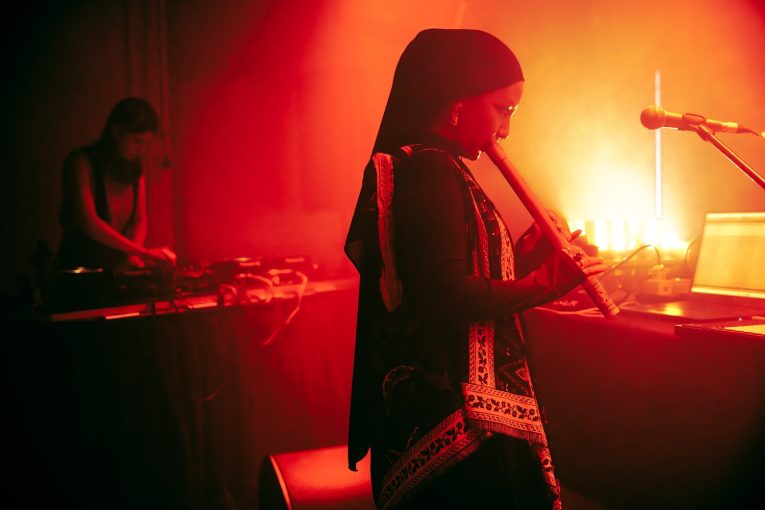
In central Melbourne, an experimental music performance became a medium for Indonesian sound artist Rani Jambak to express concern over the environmental crisis unfolding in Sumatra. Through layered rhythmic and electronic soundscapes, she brought the realities of ecological disaster and human loss into an international arts space.
In December 2025, Rani performed at Inter.Sonix 06, an international curatorial program initiated by the non-profit arts organization Liquid Architecture (LA) in Naarm/Melbourne. Her performance, titled Sounds from Sumatra in Melbourne, went beyond sonic exploration to become a cultural intervention—transforming the concert stage into a site of testimony on environmental destruction and the failure of ecological protection in her homeland.
“I did not come here bringing joy,” Rani told the audience. “I came carrying news of mourning from Sumatra.”
A Space for Sound and Listening
Founded in 1999, Liquid Architecture is recognized as one of Australia’s key platforms for experimental art, positioning sound and listening as critical practices. For more than two decades, LA has fostered dialogue between Australia and the Global South, including Southeast Asia, supporting artistic practices that challenge genre boundaries while engaging directly with social and political realities.
Rani Jambak’s participation was part of Inter.Sonix, LA’s flagship curatorial series highlighting contemporary sonic practices from Southeast Asia. Previous editions have featured influential Indonesian artists such as Sipaningkah (Aldo Ahmad), Rully Shabara, Mahamboro, the collective Yes No Klub, and Woto Wibowo.
“Inter.Sonix gave me the freedom to speak honestly,” Rani said. “Here, sound doesn’t have to be neutral. It can be sad, angry, and take sides.”
Artistic Journey and Sonic Heritage
Rani’s Melbourne visit unfolded across two key moments. On 9 December, she took part in the public discussion Li( )stening Exchange: Sonic Heritage at CY Space, where she shared her artistic trajectory and the philosophical foundations of her practice.
Australia holds particular emotional significance for Rani. She completed her master’s degree at Macquarie University, Sydney, graduating in 2018. The academic and cultural experience marked Australia as a crucial point in her artistic development.
During the discussion, Rani reflected on her early project For My Nature, which stemmed from a personal experience at the Melbourne Museum seven years earlier. There, she encountered a sustainability principle from the Gunditjmara, one of Australia’s Aboriginal clans: “You should never take more than you need.”
“The sentence is simple, but it shook me,” Rani recalled. “I immediately compared it to what’s happening in Sumatra—we take too much, too fast, without giving nature time to recover.”
She also introduced Kincia Aia, a self-built sound instrument inspired by traditional Minangkabau waterwheels. More than a musical device, the instrument functions as an archive of local knowledge and a symbol of the relationship between humans, nature, and technology.
“Instruments are not just about sound,” she explained. “They carry ways of living and environmental ethics.”
Global Rhythms, Local Wounds
The highlight of Rani’s visit took place on 12 December at Performance Inter.Sonix 06, held at Miscellania in Melbourne’s CBD. The evening also featured RP Boo, a pioneer of Chicago footwork, and Australian experimental percussionist Will Guthrie. Within this transnational rhythmic dialogue, Rani introduced the sonic landscapes of Sumatra into the language of global electronic music.
Despite the high-energy format of the performance, Rani emphasized that celebration was not her starting point.
“While I was here, hundreds of people back home lost their lives due to ecological disasters,” she said. “I felt it was important to bring that grief into this space.”
The most emotionally charged piece in her set was “Regang,” a term referring to the final breath—the stretching of life at its edge. Though constructed in a rhythmic framework, the work emerged as the most overtly political statement of the performance.
Regang was developed through a collaboration with Indonesian fashion designer Toton Januar, drawing inspiration from Sumatra’s historical identity as Swarnadwipa—the “Island of Gold,” once associated with abundance and prosperity, now symbolically portrayed as struggling for breath amid widespread forest destruction.
Over the course of approximately 40 minutes, Rani performed Kincia Aia (Malenong M(A)so), Regang, Suara Minangkabau, Distortion Journey, Orang Piaman, Kembang Mengembang, and Joget Sumatera—a collective sonic narrative she refers to as Sounds from Sumatra.
Recurring Ecological Trauma
Through her performance, Rani voiced the wounds endured by communities across Sumatra. The mourning she carried onto the Inter.Sonix 06 stage is rooted in two interconnected ecological tragedies that remain unresolved.
The first is the environmental conflict surrounding the 510 MW Batang Toru Hydropower Project, located within the Batang Toru Ecosystem—the sole habitat of the Tapanuli orangutan (Pongo tapanuliensis), the world’s rarest great ape species, with an estimated remaining population of only 500–700 individuals. Legal challenges filed by environmental activists against the project were rejected in 2019, paving the way for accelerating habitat fragmentation.
The second tragedy occurred in late November 2025, when flash floods and landslides carrying logged timber struck North Sumatra. The disaster claimed more than 900 lives, including nearly 100 deaths within the Batang Toru ecosystem, with dozens still missing. The event reinforced long-standing warnings from environmental groups about extreme ecological pressure in the region.
Public pressure following the disaster ultimately prompted government action. Indonesia’s Ministry of Environment temporarily suspended the operations of PT North Sumatera Hydro Energy (NSHE) and several other extractive companies in the Batang Toru area starting 6 December 2025, pending environmental audits and evaluations.
Music as Critique and Advocacy
Through Inter.Sonix 06, Rani Jambak transformed personal experience, failed environmental advocacy, and collective grief into a public critique resonating on a global stage. Her work serves as a reminder of the severe threats facing the Tropical Rainforest Heritage of Sumatra (TRHS)—a UNESCO World Heritage Site since 2004, listed as World Heritage in Danger since 2011.
“If the forest no longer has a voice, let music speak,” Rani concluded. “In whatever form and through whatever medium, the world needs to know that Sumatra is calling—and its breath is growing shorter.”
Author: Bachtiar Djanan
Photo Credit: Liquid Architecture