Restituting, Reconnecting, Reimagining Sound Heritage (Re:Sound)
Institutions : Universitas Gadjah Mada (UGM) and Universiteit van Amsterdam (UvA)
Funding Body : The Dutch Research Council (NWO)
Application Deadline : 5 May 2025
Start Date : 1 August 2025
Duration : 3 years (full-time)
Project Overview
Re:Sound renegotiates Eurocentric understandings, conceptions and curations of “heritage”. This Eurocentrism obscures the coloniality of the history that “heritage” is supposed to narrate and obstructs the access of source community stakeholders to their own “heritage”. There is no scholarly or curatorial model to decenter European agencies and diversify understandings of heritage (curation). Re:Sound bridges this knowledge gap by focusing on sonic heritage, in particular two colonial sound collections from Indonesia, now located in the Netherlands, The Jaap Kunst Collection at the University of Amsterdam, and the Philips Holland Omroep-Hollandse Indies radio broadcasts at the Netherlands Institute for Sound and Vision (NISV).
Re:Sound explores whether and how the inherent divergence of validations and understandings of sonic expression provides ways to reconsider established notions of heritage. It does this through Southeast Asian PhD and stakeholder research in the above Netherlands-based sound collections, and by fostering a transcontinental and inter-Asian curatorial network of academics and source community stakeholders through workshops and summer schools.
With these activities, Re:Sound aims to improve access to Netherlands-based sound collections for Southeast Asian source community researchers and stakeholders. This improvement emphatically includes options for physical and digital restitution. Through the research of the next generation of Southeast Asian scholars and stakeholders, Re:Sound moreover employs colonial sound recordings as historical sources, attending to those recorded voices that are not represented in written historical sources and hence run the risk of being “written out” of history.
Through a more inclusive historiography due to it being sound-source based and through improved access of source community stakeholders to their own heritage, Re:Sound redirects curatorial agency to Southeast Asian stakeholders – a redirection that impacts a diversification of notions of “heritage” and a decentering of European agency in heritage curation).
The Collections
The NISV holds the radio broadcasts of the Philips Holland Omroep-Hollandse Indies radio and various uncatalogued audio and video recordings related to the Dutch East Indies from the 1920s. They contain music, rituals, broadcasts of political and cultural events, speeches, debates, interviews and the coverage of insurgencies, festivities, revolts, and wars. NISV’s catalogued collections are hosted on CLARIAH and DANS, online access platforms and interfaces that are only available to researchers physically present in the Netherlands.
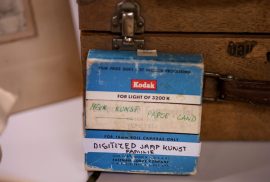
The University of Amsterdam (UvA) holds the Jaap Kunst Collection, consisting of 300+ sound recordings on wax cylinders from the islands of Nias, Sumatera, Java, Bali, Kalimantan, Sulawesi, Flores, Sumba, Timor, Kisar, the Kai Islands, the Moluccas and West Papua; hundreds of musical instruments from those locations; silent films registering dance and performance practices from those locations; 6,500 photographs of music and dance practices, and musical instruments from those locations; research reports of research expeditions to these locations; 40,000 pages of correspondence in Dutch, English, German, Indonesian/Malay and Javanese, with researchers (both within and outside Indonesia from a variety of disciplines), informants, officials, musicians, cultural entrepreneurs, and academic and archive institutions; teaching materials; publication manuscripts.
Jaap Kunst (1891–1960) and his wife Katy Kunst-Van Wely (1897–1992) “produced” this material (through recording, assembling, organizing, categorizing, annotating, writing and publishing) between 1919 and 1934 when he was a civil servant of the Dutch colonial administration in the Dutch East Indies. Through this work and his excellent international networking skills, Jaap Kunst continues to be regarded as a “founding father” of the discipline of ethnomusicology: Kunst’s methodological approaches were adopted in virtually the entire Anglophone academic world. His Collection is, therefore, one of the richest and well-known ethnographic collections worldwide, pertaining to the history of Indonesia, the performance cultures of Indonesia, colonial history, and the history of science (anthropology and ethnomusicology.
PhD Programme
This project offers one (1) fully funded PhD position in sound heritage studies at UGM with the following
Supervisory Team:
- Supervisor: Dr. Sri Margana (UGM)
- Co-Supervisor: Dr. B. (Barbara) Titus (UvA) and Dr. M.J. (meLê) Yamomo (UvA)
Candidate Responsibilities:
Complete the doctoral dissertation with contractual obligations.
Co-author at least one peer-reviewed article with the supervisory team.
Collaborate with digital archivists and local heritage organisations to develop the repository.
Present findings at international conferences (e.g., EUROSEAS, ICAS, ICTM – Southeast Asia).
Actively participate in our meetings, workshops, and summer school.
read more